
11 Elizabeth Gaskell Facts You Never Knew
I bet even classics readers can’t name more than one or two Elizabeth Gaskell facts when prompted.
Elizabeth Gaskell was one of the most talented Victorian novelists, but she often gets overshadowed by more popular writers, like the Brontë sisters and Charles Dickens.
Even as an English major in college, I only learned about Elizabeth Gaskell as the author of the important Charlotte Brontë biography, and not as a novelist in her own right. What a shame! Because it’s been such a joy to discover the works of Elizabeth Gaskell now, in adulthood.
She was alive when Jane Austen was publishing her enduring novels, and a contemporary of Dickens and the Brontës, yes, but she held her own in terms of literary merit. Let’s get to know a little bit about this fascinating English writer, because I think it always gives us more insight into an author’s books when we have an understanding of context.
Elizabeth Gaskell was born Elizabeth Stevenson in 1810. She published her first novel, Mary Barton, in 1848, then went on to write 7 more. In total, Elizabeth Gaskell wrote 8 novels, 1 biography, and countless short stories and even poems. She died of a heart attack in 1865 (aged 55). These are the most basic facts of her life, but when we dive deeper, we uncover all sorts of incredible Elizabeth Gaskell facts.
Let’s take a dive into her life’s history and uncover more about this underrated female writer.
Don’t forget to pin this post for later.

As always, this post may contain affiliate links, which means at no additional cost to you, shopping from them may generate small commissions to support the operations of this blog.
Whenever possible, I recommend buying books at local bookshops or through Bookshop.org, because shopping there puts the profits right into the hands of indie bookstores all over the country.
You can check out my Elizabeth Gaskell reading list on Bookshop here:
She was both a Minister’s daughter and a Minister’s wife
Freud might have something to say about this, but Elizabeth was born the daughter of a Unitarian Minister and, when her time came to marry, she married a Unitarian Minister. Her husband was William Gaskell, the Minister at the Cross Street Chapel in Manchester, UK.

The Gaskells spent their entire married lives in Manchester, what’s known as the world’s first industrial city.
Related: If you find yourself in Manchester, do not miss the Elizabeth Gaskell House at 84 Plymouth Grove!
Elizabeth Gaskell went to school in Shakespeare’s hometown
Most of Elizabeth’s early education was at home, but she spent two years at the Avonbank School in Stratford Upon Avon, best known for being the birthplace, final resting place, and hometown of William Shakespeare.
Elizabeth may have even made a school field trip to visit Shakespeare’s birthplace. That’s quite the literary crossover and one of my favorite Elizabeth Gaskell facts.

Related: Did you know that you can visit two Shakespeare sights in Virginia? You can see a play at the Blackfriar’s Playhouse and also see a replica of Anne Hathaway’s cottage in a hidden gem of a small town in Virginia.
Her most lighthearted novel, Cranford, is based on her hometown

Elizabeth Gaskell’s mother died shortly after giving birth to her (hmmm…. This is an interesting pattern to me, as the same is true of Mary Shelley, another remarkable English writer). Her father, overwhelmed with responsibilities, passed Elizabeth off to her aunt, Hannah Lamb, to raise.
So, young Elizabeth moved to the town of Knutsford and was raised by her aunt. This real life town of Knutsford is not only where Elizabeth Gaskell is buried; it is also the inspiration for the town of Cranford. Actually, it’s also the town that inspired Hollingford in her final novel, Wives and Daughters.

Reader tip: You can listen to Davina Porter, one of the best audiobook readers, narrate Cranford!
Gaskell took to writing fiction for a surprising reason
For Elizabeth Gaskell, her writing career as a novelist began with the death of her infant son, Willie. He died at 10 months of scarlet fever, and the loss devastated Elizabeth. She fell into a deep depression.
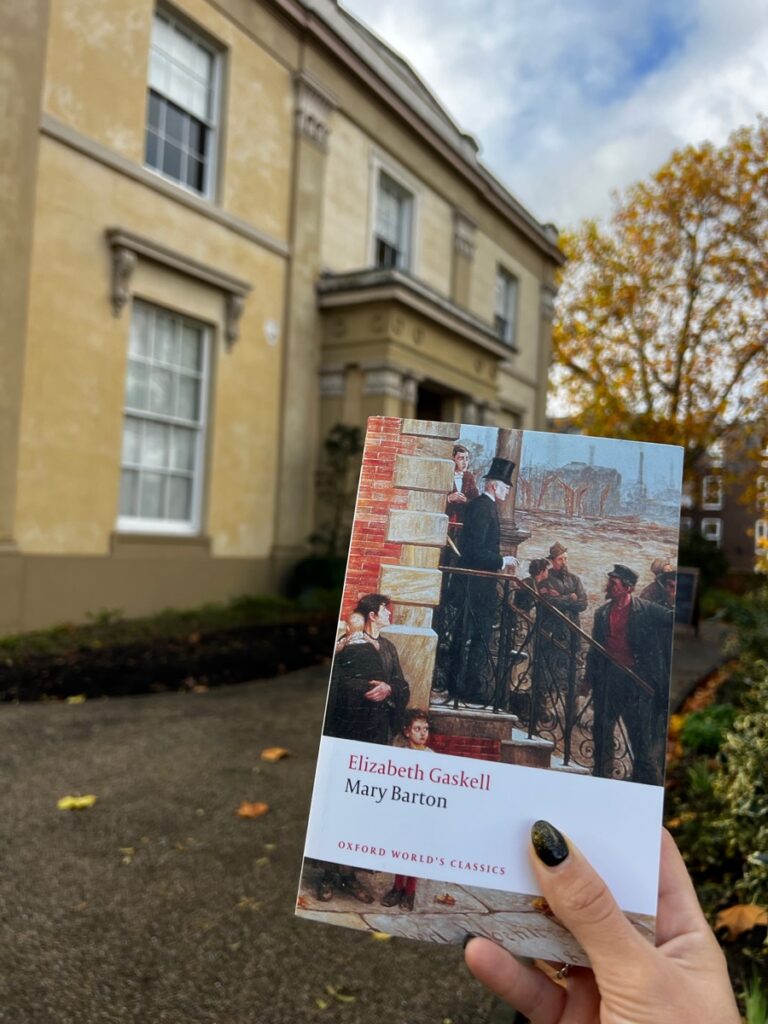
Wanting to be helpful, her husband encouraged her in her budding interest for writing. Thus, Elizabeth Gaskell began writing her first novel, Mary Barton: A Manchester Tale. In this book, she sought to convey the experiences of the poor working class of Manchester, the world’s first industrial city.
Mary Barton was immediately popular in the UK, though not as popular closer to home. The rich factory owners of Manchester, many of whom were members of her husband’s congregation, weren’t too happy with how they were depicted in the novel. That had to make for some awkward dinner parties.
Gaskell’s own church members burned her books
This one is perhaps one of the most surprising Elizabeth Gaskell facts: members of her own church congregation publicly burned copies of her novel, Ruth. Mary Barton might have rankled some Manchester people, but with Ruth, they were downright furious.
This Elizabeth Gaskell novel tells the story of a 15-year-old seamstress, Ruth, who is seduced by a wealthier boy and gives birth to an illegitimate child. It is the novel of the Fallen Woman. Throughout the novel, Ruth tries to redeem her life, though she’s thwarted at every turn.
Many people in the Gaskells’ congregation thought this depiction of the fallen woman took it too far, and they publicly burned copies of her book. Can you imagine the scandal? The headlines? “Church Members Burn Scandalous Book Written by Minister’s Wife.”
Related: Gaskell isn’t the only one whose hometown burned her books. Salinas also burned Steinbeck’s books during his lifetime. The Berlin Book Burning Memorial is a creative and moving tribute to the books that were lost in Nazi book burnings
Gaskell was a unicorn among Victorian writers
If you think about most female Victorian or Edwardian novelists you know of, you might notice a pattern — they stayed single. It’s no wonder, when you consider what was expected of wives and mothers and the amount of responsibilities they carried (not that we’ve completely changed since then, but that’s a discussion for another day).
Elizabeth Gaskell somehow managed to do it all — she was a wife (and a minister’s wife, no less), had 5 children, and wrote an impressive amount of novels and stories by any standard.
As Claire Tomalin so aptly summarizes this accomplishment,,
“With no more education than any other nice girl born in 1810; with marriage at twenty-one, and seven pregnancies thereafter; with all the domestic and social duties of the wife of a Unitarian minister, and the care and upbringing of her children; not to mention a taste for travel – prison visiting and humanitarian work among the poor – a social life as exuberant as that of Dickens and a circle of friends as large – with all this, still, at the age of thirty-six she became an enormously successful and respected writer in a hugely competitive and brilliant field.”

Charles Dickens was a fan (but had some serious issues)
When you read Mary Barton, and Gaskell’s treatment of industrialization, class warfare, and poverty, it’s obvious why Charles Dickens would be her fan. After reading Mary Barton, Dickens wrote to Gaskell and requested that she contribute to his new periodical, Household Words. In fact, he really gushed over her:
“I do know honestly that there is no living English writer whose aid I would desire to list in preference to the authoress of Mary Barton (a book that most profoundly affected and impressed me).”
She did contribute to his periodicals, and in fact, many of her popular novels were serialized in it. However, it was not all rosy between Dickens and Gaskell. Gaskell struggled with the restrictions of writing novels serially and often didn’t meet deadlines. Dickens wrote in a letter to a friend that if he were her husband,
“Oh heaven how I would beat her.”
So, there’s that. Dickens expressed a desire to beat her, how’s that for Elizabeth Gaskell fun facts.
Related: I might not be a fan of what Dickens had to say about Gaskell here, but the Charles Dickens Museum is one of my favorite literary sights in London.
Elizabeth Gaskell and Charlotte Brontë were kind of besties
Despite the stark differences in their temperaments (Gaskell was a garrulous extrovert, in contrast to Brontë’s extreme introversion), Elizabeth Gaskell and Charlotte Brontë got on like peas and carrots. Charlotte Brontë stayed with the Gaskells in Manchester multiple times and described Elizabeth as “kind, clever, animated, and unaffected.”
When Charlotte died, her father specifically requested that Elizabeth Gaskell write her biography. She did so, and in so doing got drawn into lots and lots of drama (libel suits, general uproar). Still, to this day Elizabeth Gaskell’s The Life of Charlotte Brontë is considered an important and impactful work.
Gaskell wrote part of North and South while staying with Florence Nightingale
In case you hadn’t picked up on this Elizabeth Gaskell fact yet, she kind of rubbed shoulders with a lot of important people. One of those was Florence Nightingale, with whom she was friendly. She stayed with Nightingale for an extended time while writing North and South, one of my personal favorite Elizabeth Gaskell novels.
When she had four children to care for at home, it’s easy to imagine that writing elsewhere would’ve been a little easier for her. When I toured the Elizabeth Gaskell home, the docent claimed that her husband encouraged her to take these longer trips so that she could concentrate on her writing.
Reader tip: North and South is a fantastic novel, and it has also been adapted into a BBC series. Honestly, it’s up there with the 1995 Pride and Prejudice for me.
Elizabeth Gaskell assumed a pen name, but it… kind of gave her away
When she first started writing, Elizabeth Gaskell published under the name Cotton Mather Mills. Publishing under a male name was a common practice for women writers in the 1800s, as they (and publishers) didn’t believe people would read books written by women, nor did society look too kindly on women writers. The Brontës adapted male names like Currer and Acton Bell. Jane Austen didn’t adapt a male name but published as “A lady.”
When Elizabeth Gaskell published her first novel, Mary Barton, she published it anonymously, that is, with no authorial attribution at all. But it wasn’t long for people to find out the real identity. After that, she wrote simply as, “Mrs. Gaskell.”
Gaskell’s husband worked the system to get her library access

Elizabeth Gaskell’s husband was a member of the local public library, the Portico Library. That meant he had access to hundreds of books and periodicals he could borrow. As Elizabeth was a woman, she was denied membership. So, her good husband would write down the requests of Elizabeth and their daughters and check them out for them in his own name.
Well, that’s a wrap up on these fascinating facts about Elizabeth Gaskell. Did you learn anything new about this incredible author? Add any books to your TBR?
Don’t forget to pin this post so you can come back to it later, and subscribe so you don’t miss any bookish content.





Fun post! I’ll have to check out Gaskell’s work.
Yes, please do! I especially recommend North and South.
I am a massive Elizabeth Gaskell fan and this post made me incredibly happy 🙂 what a wonderful tribute to this amazing lady and her works!!
Oh I’m so glad to hear that! Elizabeth Gaskell deserves ALL the love!