


The Empty Library, Berlin’s Memorial to Burned Books
Ever heard of Berlin’s Bebelplatz and the chilling Empty Library memorial there?
For the past few years, I’ve been traveling all over the US and Europe hunting down the hidden literary travel sights that any book lover should visit. Sadly, information on literary travel can be hard to come by, and there’s nothing worse than the regret of finding out about a location after your trip is already over.
So, what about literary travel sights in Berlin, Germany? In addition to the excellent Berlin bookshops, Berlin also has one very important literary travel sight that every book lover needs to visit: The Empty Library, a memorial to the Nazi book burnings that took place in 1933.
I’ll tell you all about the history of this important site at Bebelplatz and how to visit it yourself.
This topic is particularly salient right now, not only because it is Banned Books Week in the US, but also because book bans are on the rise in the United States. PEN America recorded 3,362 instances of book bans in US K-12 schools in the 2022-2023 school year, a 33% increase from the previous academic year.
No time to read now? Pin this post and come back to it later, when you’re planning your trip to Berlin.

As always, this post may contain affiliate links, which means at no additional cost to you, shopping from them may generate small commissions to support the operations of this blog.
Whenever possible, I recommend buying books at local bookshops or through Bookshop.org, because shopping there puts the profits right into the hands of indie bookstores all over the country.
About Bebelplatz, site of the 1933 Berlin Book Burning
Berlin’s Bebelplatz, or the Opera Square, is the site of the most infamous book burning event in modern history. On the night of May 10, 1933, 40,000 people converged on Bebelplatz in front of the Berlin Opera House to witness or participate in the Nazi spectacle that was a prelude to the physical and idealogical warfare of World War II.
On May 10, students from Wilhelm Humboldt University, most of them members of student right wing organizations, marched in Nazi uniform to Bebelplatz in Berlin. They escorted a caravan of 6 vans filled with books from their university libraries, books they’d deemed un-German, and tossed them into a bonfire.
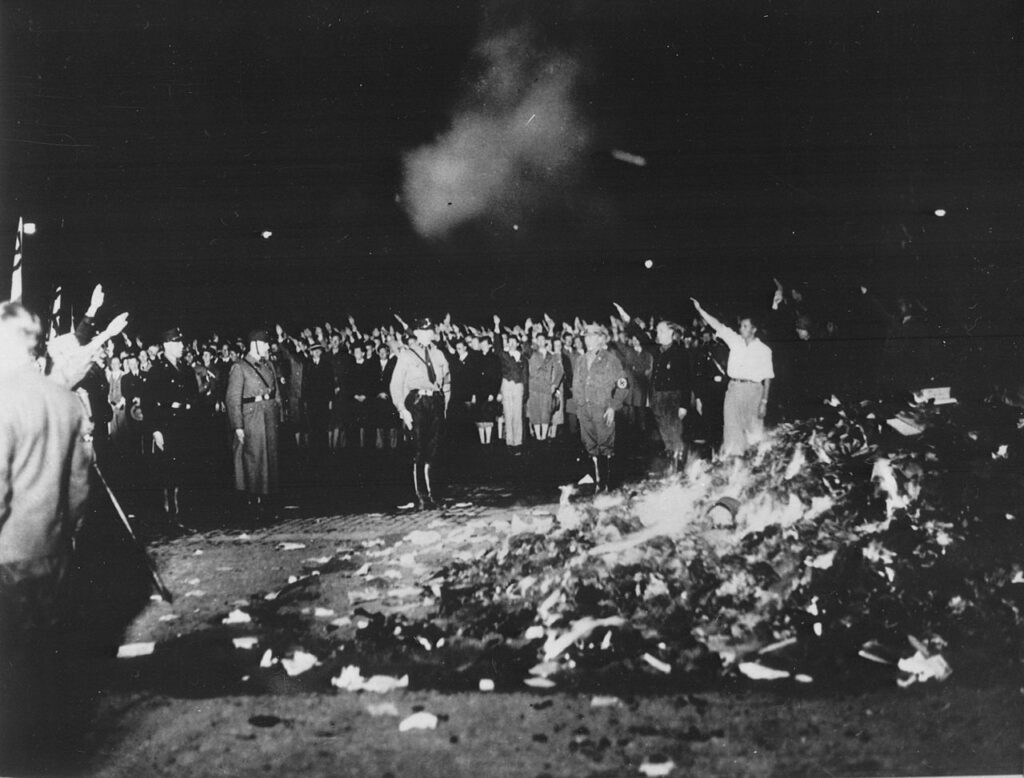
To commemorate the Berlin book burning, Hitler’s Minister of Public Enlightenment and Propaganda, Joseph Goebbels, gave a speech on the occasion. His words were broadcast on the radio around Germany, inspiring students to take similar action in their towns and universities.
In his speech, Goebbels declared,
“The era of extreme Jewish intellectualism is now at an end. … The future German man will not just be a man of books, but a man of character. It is to this end that we want to educate you. … And thus you do well in this midnight hour to commit to the flames the evil spirit of the past.”
Joseph Goebbels at the 1933 berlin book burning
While the Berlin book burning at Bebelplatz is the most famous incident of book burning in Germany, it was not the only one. Elsewhere around the country, students in 33 other cities and towns also gathered to burn books.
Altogether, students burned over 25,000 books across Germany on May 10, 1933. Among the burned books were those by Jewish authors like Sigmund Freud and Albert Einstein. They also burned books they saw as upholding indecent or un-German ideals, including works by Thomas Mann, Karl Marx, Jack London, Sinclair Lewis, Ernest Hemingway, and Helen Keller.

In an open letter to the students who burned her books, Helen Keller responded:
“You can burn my books and the books of the best minds in Europe, but the ideas in them have seeped through a million channels and will continue to quicken other minds… I deplore the injustice and unwisdom of passing on to unborn generations the stigma of your deeds.”
Helen Keller
The famous Berlin book burning was an incendiary event, not just literally, but figuratively as well. It set the standard for the new regime’s ideals, that of the Third Reich.
The book burning at Bebelplatz also partially inspired the American literary classic, Farenheit 451, by Ray Bradbury. The American writer acknowledged,
“When Hitler burned a book I [a lover of libraries] felt it as keenly, please forgive me, as his killing a human, for in the long sum of history they are one and the same flesh. Mind or body, put to the oven, is a sinful practice, and I carried that with me.”
Ray Bradbury
Visiting Bebelplatz and the Empty Library
In acknowledgment of this infamous night in German history, the city of Berlin sponsored a memorial in Bebelplatz in memory of the books that were burned there. The winning design was submitted by Israeli artist Micha Ullman and is commonly called, “The Empty Library,” or “The Library.” It was installed in 1995.

If you don’t know to look for it, you might miss the book burning memorial entirely. You may just find some tourists congregating around a random spot in front of the Opera House and have no idea what they are stopping for.
The Empty Library is brilliant in its subtlety. The book burning memorial is an underground, 7×7 meter room, lined with empty, white bookshelves. These empty bookshelves are enough to fit the 20,000 books that were burned on May 10, 1933 in Berlin. It is a memorial that visually depicts absence, and what was lost.

Nearby, a discreet plaque displays, in German, the famous quote by Heinrich Heine, spoken a century before the infamous Berlin book burning:
“Wherever they burn books, they will, in the end, burn human beings.’”
Heinrich heine
Another understated plaque next to it reads, ““In der mitte dieses platzes verbrannten am 10, May 1933 National Sozialistische studenten die werke hunderter freier schriftsteller, publizisten, philosophen und wissenschaftler.” Translated to English, it means:
“In the middle of this square on May 10, 1933, National Socialist students burned the works of hundreds of freelance writers, journalists, philosophers and scientists.”

Related: Traveling to Frankfurt on your Germany trip? Check out the Gutenberg Museum near Frankfurt, a museum dedicated to the history of book printing.
Where to find the book burning memorial
To visit the Empty Library, make your way to Bebelplatz. It’s easily accessed by walking or by public transportation, including the Bus 100, which stops at many of the main tourist sites in Berlin.

Buses 147 and 300 also stop at Bebelplatz. If going by Subway, you can get off at Bebelplatz from lines U2, U5, and U6, and by trains S1, S25, S5, and S9.
To find the Berlin book burning memorial, look for the Berlin Opera House as a landmark. The Empty Library is installed beneath the ground of Bebelplatz, roughly in the center of the square in front of the Opera House. You will view the memorial from above, through a glass pane.
The memorial is particularly impactful when viewed at night, when the library is lit up, making the shelves’ emptiness feel even more moving.
Is The Empty Library Worth Visiting in Berlin?
There’s no denying that Berlin is a massive city with a lot to keep one occupied. It can be difficult to narrow down one’s itinerary to seeing the best sites, taking in the history, museums, artsy scene, and the famous Berlin nightlife (and also, all the amazing bookstores for us traveling book lovers!).

However, I do think that every visitor to Berlin should take a moment to visit the Empty Library while in the city. As it’s so centrally located, free, and doesn’t require any lines or admittance, it hardly takes a moment from your Berlin sightseeing.
The Empty Library is an easy stop on your way to Museum Island, where you can visit some very cool free museums in Berlin, as well as some that charge admission (book in advance!), or to fit in before a Berlin food tour.
The Berlin book burning memorial is a moving tribute and a good reminder to all visitors of the value of books, literature, and freedom of speech, especially in light of the increasing number of book bans happening in the US.
Travel Resources At-A-Glance
All of the following are links to sites and services I actually use to book and plan my travel or to purchase books or travel gear.
For flights: Skyscanner is my number one go-to resource for booking flights. I love using the “explore” function to find the cheapest places I can fly during a given time or using the fare calendar to identify the cheapest days to fly.
For hotels and lodgings: For hotels, hotels.com, and for vacation rentals, VRBO.com. I’ve had much better experiences with private rentals through this website than through other popular private vacation rental websites.
For car rentals: Kayak allows comparisons across a wide range of booking agencies and lists reviews of companies as well. I’ve found this to be the most user-friendly and efficient way to compare car rental prices.
For tours & excursions: Viator and Get Your Guide are my top choices for booking excursions and tour experiences in a new destination.
For travel gear: Amazon.com and REI for more outdoorsy items. Check out my travel gear recs here.
For booking trains & buses: I find the Omio app and website to be the most easily navigable for comparing options for public transportation, especially in Europe,
Best travel credit card: My favorite travel rewards credit card for European travel has been the Chase Sapphire Rewards card. Visa is accepted just about everywhere in Europe, and there are no foreign transaction fees on the card. Some of the travel benefits I love on the Chase Sapphire include free TSA pre-check or Global Entry (worth it every time), an annual $200 travel credit, an annual $200 hotel benefit, built-in rental car, and trip insurance, and points are worth 50% more when used to book travel. I travel around Europe a LOT, and I end up with many free flights and hotel stays from using my points on my Chase Sapphire.
For books: Bookshop.org often has prices as good as Amazon or sometimes better, but profits go to indie bookstores all over the country. Whenever possible, consider buying your books from this online indie bookshop resource.
Have you visited Berlin before? Did you know to visit Bebelplatz at the Empty Library? What other European cities are you visiting and need to know the best literary travel sights there?
Don’t forget to pin this post for later.