


Should you visit the Mainz Gutenberg Museum? A complete guide
Are you planning a trip to Germany and wondering what there is to do near Frankfurt?
One place that might be worth checking out if you are a bibliophile and/or a history enthusiast is the nearby Mainz Gutenberg Museum. In an easy day trip from Frankfurt, you can visit the Mainz Gutenberg Museum, dedicated to the history of book printing and the inventor of the movable type printing press and Mainz native, Johannes Gutenberg.
For the last several years, I’ve been hunting down all the best literary travel destinations in the US and Europe and sharing everything you need to know about these often overlooked sights. During Christmas market season, I finally got to visit not only the Mainz Christmas market but also spent some time exploring the Gutenberg Museum.
In this post, I’m going to tell you what you can expect from a visit to the Mainz Gutenberg Museum and help you decide whether or not it’s worth your time to go while in Germany.
We’ll get into all the details, but I’ll go ahead and tell you right now: if you’re not a German speaker, you should plan ahead to make the Gutenberg Museum worth visiting. A spontaneous visit may be worth it if you have time to fill, but you’ll probably get less from it than you otherwise could.
Don’t forget to pin this post to reference when planning your trip to Germany.

As always, this post may contain affiliate links, which means at no additional cost to you, shopping from them may generate small commissions to support the operations of this blog.
Whenever possible, I recommend buying books at local bookshops or through Bookshop.org, because shopping there puts the profits right into the hands of indie bookstores all over the country.
Who was Gutenberg?
Johannes Gutenberg was a 15th century inventor from Mainz, Germany. He is most well known for his invention of the movable type printing press and for printing the famous Gutenberg Bibles.

Not much is actually known about Johannes Gutenberg’s life, including his birth date, or even what he looked like. Images of the inventor, like the one above, are a complete fabrication, though artists have been pretty consistent with this fictional depiction of him.
While Gutenberg’s printing press changed the world (read about it in the next section), it took time before there was actually a market for printed books. Gutenberg died penniless and in debt, his printing presses seized by his creditors.
Gutenberg’s Printing Press: why it matters
Gutenberg’s printing press is generally regarded as one of the most transformative inventions in the history of mankind. Think about it — before the movable type printing press was invented in the 15th century, there was no reliable way to widely share information (or learn it, for that matter).
I think in today’s world, where if anything we suffer from an information overload from our constant access to people and the internet, that’s hard to fathom. But people’s knowledge of the world was generally limited to their immediate geographic circle and word-of-mouth.
Before Gutenberg’s printing press, books were painstakingly copied by hand, making them scarce, expensive, and completely inaccessible to your average Jane. Gutenberg’s innovation of a movable type printing press enabling the mass production of not just books, but newspapers as well.

The result wasn’t just that they could create and print books as we know them today. It also meant the revolution of the scientific process, because now scientists could widely share their findings, building upon each other’s discoveries instead of each working in an information vacuum.
Francis Bacon, creator of the scientific method, said that the three inventions that forever changed the world were gunpowder, the nautical compass and the printing press.
Also, famously, Gutenberg used his movable type printing press to mass produce Bibles for the first time. These are now known as the Gutenberg Bibles, and there were about 200 copies made.

Gutenberg’s printing press directly enabled and fueled the Renaissance and the Reformation, eras that saw huge leaps in the advancement of human knowledge and creativity.
Related: Are you heading to Berlin? It’s one of my favorite cities in Europe for finding English language bookshops, plus you can visit the Book Burning Memorial, a sight you shouldn’t miss!
The Mainz Gutenberg Museum
Johannes Gutenberg was a resident of Mainz, Germany, just a stone’s throw from Frankfurt. Today, his hometown honors him and his invention with the Mainz Gutenberg Museum, so visitors can learn more about the important invention and the man behind it.
The Mainz Gutenberg Museum covers over 3,500 square feet filled with exhibits about Gutenberg, his printing press, and more broadly, the history of book printing.
Because very little is actually known about Gutenberg, there’s actually not much biographical information about him in the Mainz Gutenberg Museum. Instead, visitors can expect to find exhibits showing the development of printing since Gutenberg as well as the history of printing in Asia, like the invention of woodblock printing.
Here are some of the exhibits that are worth checking out at the Gutenberg Museum near Frankfurt:
The Gutenberg Bibles
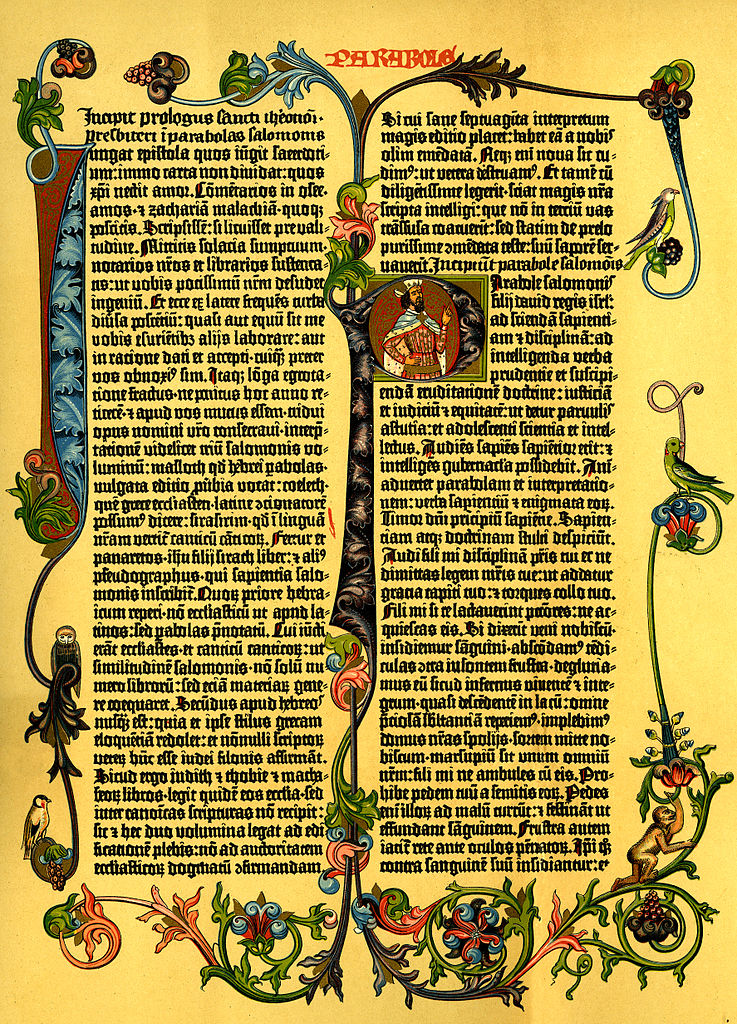
In perhaps the biggest draw at the Mainz Gutenberg Museum, visitors can enter a secure vault and see two of the original Gutenberg Bibles on display. Note that no photos are allowed inside the vault (a guard is posted there to make sure), and the bibles themselves are (obviously) protected underneath thick glass. Still, they are pretty remarkable to see.

Here are a couple of facts about the Gutenberg Bibles I learned at the Mainz Gutenberg Museum:
- There were 200 Gutenberg Bibles printed over a period of several years, because the process took so long
- When printing the Gutenberg Bibles, spaces were left for people to fill in by hand, such as the illuminated letters beginning pages or paragraphs.
- Because part of the Gutenberg Bibles were filled in by hand, every Gutenberg Bible is unique; no two are the same.
Recreated Gutenberg Printing Press
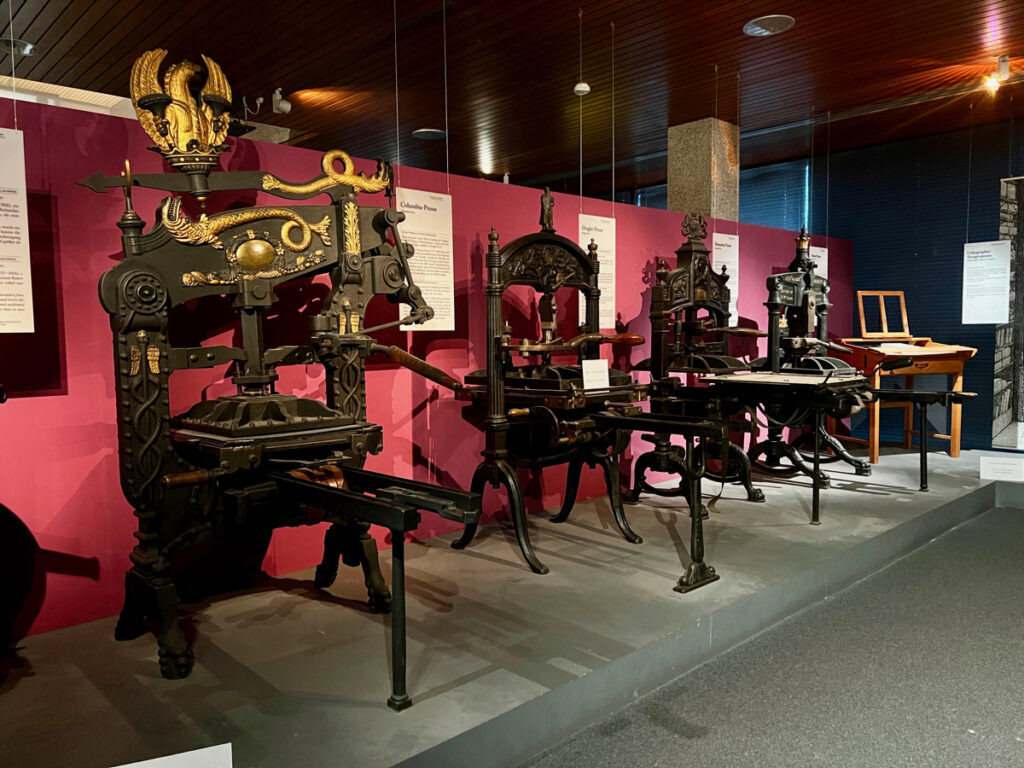
None of Gutenberg’s original printing presses are still in existence today, but at the Mainz Gutenberg Museum, you can view a recreation of Gutenberg’s printing press to the extent that we know of it.
It was built based on woodcuttings of the press from the 15th and 16th century, and at times throughout the year, there are demonstrations (in German) of how the printing press worked. I didn’t get to catch one of these demonstrations, and information on when they start isn’t easy to find.
Bookbinding Museum
Another interesting section of the Mainz Gutenberg Museum is dedicated to the process of bookbinding. If you’ve never paid attention to what actually goes in to the binding of books, it really is an art.
In the bookbinding section of the museum, you can see the many tools involved in bookbinding by hand, as well as books at various points in the process. It makes you appreciate all the more how much we take for granted in our books.

Tip: If you are curious about the artisanship of bookbinding, I recommend reading the novel The Binding by Bridget Collins. It’s a mystery and a love story, but there’s a good bit in there about the craftsmanship of bookbinding that made me appreciate it in a whole new light.
Gutenberg Print Shop
The Print Shop is the most interactive element of the Mainz Gutenberg Museum , dedicated to hands-on education about book printing. Here, they host special tours and workshops, and they also have professionals who print cards, documents, and other print items that businesses might order.
Special events they host include school field trips and even children’s birthday parties. You can also submit an online request for a small group to use the print shop for 1 hour during your visit.
How to visit the Mainz Gutenberg Museum
You can visit the Mainz Gutenberg Museum and Print Shop in several different ways:
- A walk-up visitor on a self-guided tour (cost: €5 per ticket)
- A walk-up visitor with a pre-recorded audio guide (cost: €3.50 + normal ticket price)
- A special guided tour by appointment (cost: €80 + museum admission, must be booked in advance)
- Small groups (up to 5) use the print shop for 1 hour (cost: €5, must submit an online request)
- You can also book a private guided tour of the Mainz Gutenberg Museum through a third party
Is the Mainz Gutenberg Museum worth visiting?
I’ll be perfectly honest with you — in my opinion, as a walk-in experience, the Gutenberg Museum doesn’t live up to its potential. The best museums are organized around a strong and clear narrative structure, but it’s hard to get your bearings in the Gutenberg Museum without a guide.
The information given at different displays isn’t terribly informative, and it’s only occasionally translated into English. Perhaps it’s more informative for German speakers, but judging just by the amount of writing, it doesn’t seem to be much better.
Tip: While the Gutenberg Museum is pretty iconic, I think the book printing museum in Lyon, France is actually more informative.
So, my recommendation is that if you’re going to visit the Mainz Gutenberg Museum, you should paln ahead and book a tour to make your time more worthwhile. At the bare minimum, I’d recommend checking out the audioguide to provide more information. I didn’t choose that option, but wished I had after the fact.
Also, I think the Gutenberg Museum visit would be much more worthwhile if you book time in the Print shop, so you can experience the process of printing firsthand.

Still, even if all you have time for is a quick stop-in, the cost of admission is cheap, and if nothing else, seeing two Gutenberg Bibles on display is worthwhile, and I came away with a renewed appreciation for books, which these days we take for granted.
Other nearby literary sights
If you’re going to spend some time in Frankfurt, you can combine a trip to Mainz with a stop at the real Frankenstein Castle. Also, in Frankfurt proper, you can explore the Goethe museum dedicated to Johann Wolfgang von Goethe.

Learn more about Gutenberg and his invention
1. “Johannes Gutenberg and the Printing Press.” Smithsonian Libraries. [https://library.si.edu/exhibition/johannes-gutenberg-and-printing-press]
2. “Johannes Gutenberg and the Invention of the Printing Press.” History. [https://www.history.com/topics/inventions/johannes-gutenberg]
3. “Johannes Gutenberg.” The Metropolitan Museum of Art. [https://www.metmuseum.org/toah/hd/gutb/hd_gutb.htm]
Travel Resources At-A-Glance
All of the following are links to sites and services I actually use to book and plan my travel or to purchase books or travel gear.
For flights: Skyscanner is my number one go-to resource for booking flights. I love using the “explore” function to find the cheapest places I can fly during a given time or using the fare calendar to identify the cheapest days to fly.
For hotels and lodgings: For hotels, hotels.com, and for vacation rentals, VRBO.com. I’ve had much better experiences with private rentals through this website than through other popular private vacation rental websites.
For car rentals: Kayak allows comparisons across a wide range of booking agencies and lists reviews of companies as well. I’ve found this to be the most user-friendly and efficient way to compare car rental prices.
For tours & excursions: Viator and Get Your Guide are my top choices for booking excursions and tour experiences in a new destination.
For travel gear: Amazon.com and REI for more outdoorsy items. Check out my travel gear recs here.
For booking trains & buses: I find the Omio app and website to be the most easily navigable for comparing options for public transportation, especially in Europe,
Best travel credit card: My favorite travel rewards credit card for European travel has been the Chase Sapphire Rewards card. Visa is accepted just about everywhere in Europe, and there are no foreign transaction fees on the card. Some of the travel benefits I love on the Chase Sapphire include free TSA pre-check or Global Entry (worth it every time), an annual $200 travel credit, an annual $200 hotel benefit, built-in rental car, and trip insurance, and points are worth 50% more when used to book travel. I travel around Europe a LOT, and I end up with many free flights and hotel stays from using my points on my Chase Sapphire.
For books: Bookshop.org often has prices as good as Amazon or sometimes better, but profits go to indie bookstores all over the country. Whenever possible, consider buying your books from this online indie bookshop resource.
Well, that should answer all of your questions about visiting the Mainz Gutenberg Museum in Germany and give you the information you need to plan your trip.
Have you ever seen a Gutenberg Bible in person?
Don’t forget to pin this post for later, and subscribe so you don’t miss out on any more overlooked literary travel destinations.


