


The Writers’ Museum in Edinburgh: Everything You Need to Know
For a traveling book lover, the Writers’ Museum in Edinburgh, Scotland is a fun stop to include on your tour of one of my favorite cities in the world.
I first visited Edinburgh fifteen years ago and fell in love with the city. I will never forget emerging from Waverly train station in the evening and finding myself in the middle of what felt like an enormous castle, with ancient stone buildings towering over me, emitting an eery, magical light. It’s a city with a totally unique character that still draws me back to it time and again.
Plus, there are tons of literary sights in Edinburgh, making it a huge draw for any traveling book lovers (and if you’re new here, that’s kind of my speciality). The Edinburgh Writers’ Museum is one of the top bookish destinations in Edinburgh to include during your trip for people interested in literature. Additionally, anyone with a broader interest in Scottish culture and history will likely find it a worthwhile stop.
You’ve probably seen photos of the gorgeous exterior of the building in your social feeds, but not much information about what’s actually inside. In this post, I’ll tell you everything you need to know to plan a visit to the iconic museum, like what you can expect to find inside, how much it costs, how to get there, and how much time to give yourself for your visit.
No time to read through right now? No problem. Pin this post so you can come back to it later.

As always, this post may contain affiliate links, which means at no additional cost to you, shopping from them may generate small commissions to support the operations of this blog.
Whenever possible, I recommend buying books at local bookshops or through Bookshop.org, because shopping there puts the profits right into the hands of indie bookstores all over the country.
The Writers’ Museum: A Quick Overview
Briefly, the Writers’ Museum in Edinburgh is dedicated to preserving the literary legacy of three of Scotland’s most famous authors: Robert Burns, Sir Walter Scott, and Robert Louis Stevenson. It houses a unique collection of artifacts relating to each author as well as a small gift shop.

The building itself is as much an attraction as anything on display inside of it. The Writers’ Museum is housed in a historic building first built in 1622 known as “Lady Stair’s House.” It’s named for Elizabeth Dalrymple, Dowager Countess of Stair, who lived there in the 1720s. Though the home went through many changes over time, in 1897 it was roughly restored to its 1600s configuration, meaning the architecture itself is a part of the museum.
Lady Stair’s House was gifted to the City of Edinburgh in 1907, and it opened as a museum in 1913, though initially with a more eclectic array of items relating to the city. This collection eventually outgrew the house and was moved to what’s now called the Museum of Edinburgh. Subsequently, the museum displayed items relating to childhood, but that collection, too, was moved in 1957 to become the larger Museum of Childhood.
After that, Lady Stair’s House narrowed its focus to what it remains today — famous writers of Edinburgh.
Related: Edinburgh is one of Europe’s UNESCO Cities of Literature. In just a three-hour train ride from Edinburgh you can find yourself taking a literary tour of Manchester, another UNESCO City of Literature.
What You’ll See at the Edinburgh Writers’ Museum
I’ve said it once, and I’ll say it again — Scotland loves its writers. I don’t know if I’ve ever visited a country that’s more visibly proud of its literary heritage (and literary travel is kind of my whole thing). The Writers’ Museum in Edinburgh is a perfect example of the love and pride they have for their authors.

On your visit, you’ll enter the striking museum via a door that leads directly into a turret and its narrow, spiral staircase leading either up or down. If you go downstairs first, you’ll find yourself in a section dedicated to Robert Louis Stevenson, while going up will take you into the rest of the museum and the central hall. It’s visitor’s choice on which direction you choose first — my recommendation is to choose the one that appears least crowded at the moment.
In the grand central room of the museum, take in the historic architecture of the home, from the larger-than-life fireplace with a tapestry of the writers above it, to the dark wood paneling and the wrought iron chandelier overhead. As you walk around the room, you’ll also see Robert Burns’s writing desk, busts of each of the three featured writers, and at the back, a small gift shop.

From the central room, you can follow signs to visit sections dedicated to Sir Walter Scott and Robert Burns.
Tip: Note that the Edinburgh Writers’ Museum is indeed a historic building, and that comes with historic staircases full of narrow, circular stone steps. Step carefully, particularly on the one painted white — this one is taller than the other stairs, as it was installed in the 17th century as a burglar alarm, hoping to trip unsuspecting thieves.
Robert Louis Stevenson Section
The Robert Louis Stevenson section of the museum is located down the spiral staircase right upon entry, apart from the rest of the museum collections as it was added on later.
Robert Louis Stevenson is one of the most successful authors to come out of Scotland, and though he spent much of his life traveling abroad, he was proud of his homeland, and it served as setting and inspiration for many of his stories and novels.
“The happiest lot on earth is to be born a Scotchman.”
Robert louis stevenson
In the Robert Louis Stevenson section of the museum, you can find many items relating to or once owned by Stevenson. Of note, you can see one of Stevenson’s traveling trunks, his riding boots, and a ring gifted to him by a Samoan chief (Stevenson spent a lot of time in the Pacific Islands and died and was buried in Samoa).

You can browse through items that Stevenson acquired during his travels while you listen to excerpts of Treasure Island (one of my favorite reads from 2023 and one of my recommended easy classic novels) playing on speakers throughout the room.
Also, take note of the large wooden wardrobe on display. This was fashioned by an Edinburgh man named Deacon Brodie, whose infamous double life (upstanding citizen by day, criminal by night) supposedly inspired Stevenson’s novel, The Strange Case of Dr. Jekyll and Mr. Hyde (which Audible subscribers can listen to for free as part of the Audible Plus catalog).
Related: As Robert Louis Stevenson was a great traveler, there are literary sights related to him all over the globe. You can visit a recreation of the hut he lived in in Hawaii, the Robert Louis Stevenson museum in Napa Valley, and even a state park named after him in California. Near Monterey, California, there is a golf course named after an iconic sight in Treasure Island. Supposedly Robert Louis Stevenson was inspired by the location.
Sir Walter Scott Section
In the main part of the Writers’ Museum, you will find a section dedicated to Sir Walter Scott, an iconic writer of Scottish historical fiction and best known for his works Ivanhoe and Waverly (for which the main train station in Edinburgh is named).
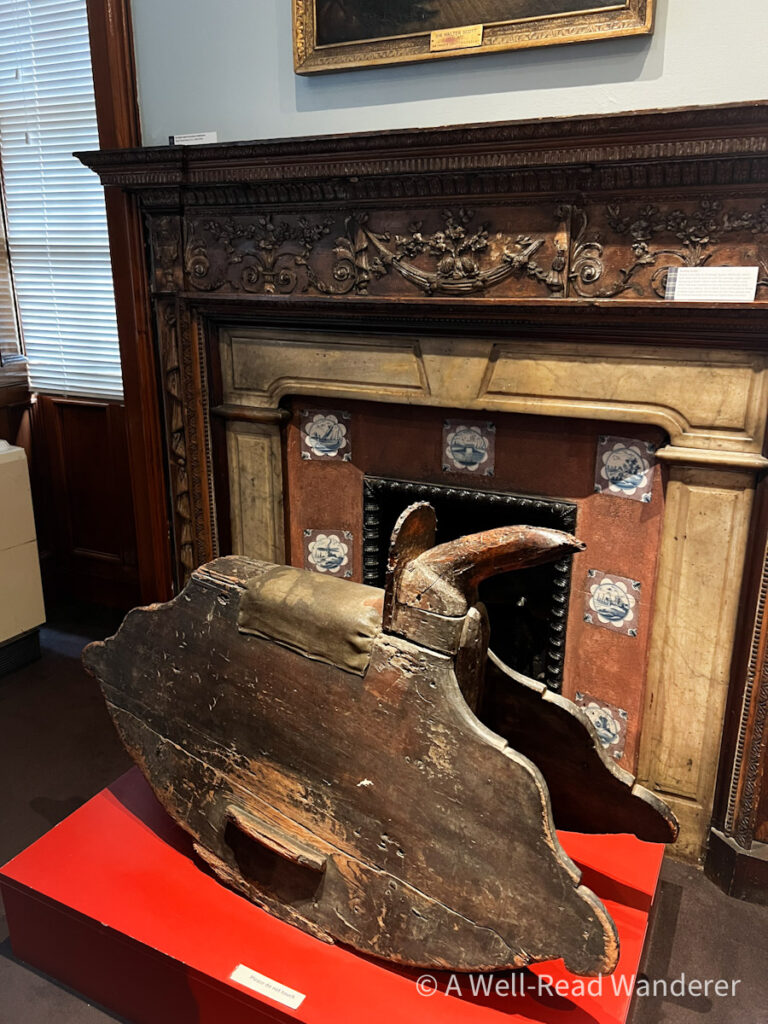
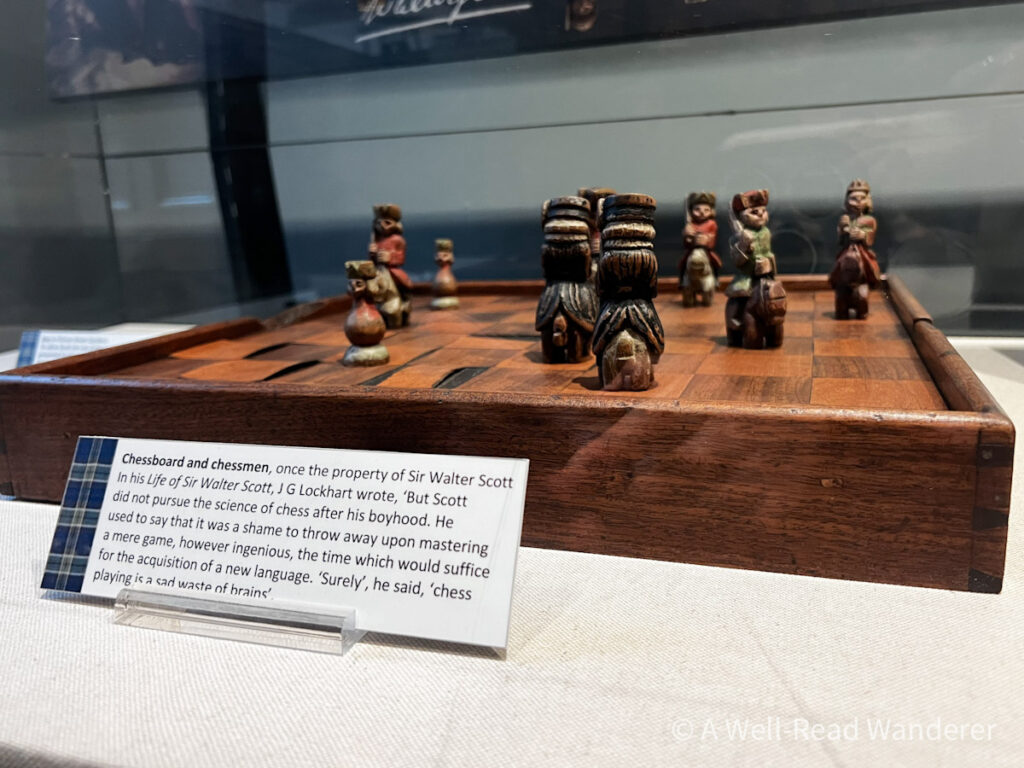
In this part of the museum, you can find a hand printing press on which Scott’s Heart of the Midlothian is believed to have first been printed. You can also see a first edition copy of Waverly, a chess board he owned as a child, and his childhood rocking horse (one foot rest is a little higher than the other, as Scott was crippled by polio as a child).

Related: Make sure you take time to see the Scott Monument while on your literary tour of Edinburgh; it’s the largest monument to a writer in the world.
Robert Burns Section
Robert Burns is far and away Scotland’s favorite poet. To the rest of the world, he is mostly known as the author of “Auld Lang Syne,” but to Scotland he is much more. What Shakespeare is to England, Burns is to Scotland. He earned his country’s pride by preserving their language and writing verses and poems in Scots. Burns rose from humble farm beginnings to become the National Poet of Scotland and an important figure in Edinburgh society.
Every year on January 25th, Scottish people commemorate Robert Burns with Burns Night Suppers, a totally unique Scottish tradition that involves, among other elements, “piping in the haggis.”

In this section of the museum, you can listen to excerpts of Burns’s poems playing overhead while you peruse an interesting assortment of items — a cast of his skull, a lock of his hair, some of his manuscripts, a chair he once owned, and more.
In the main room of the museum on the ground floor, you can also see Robert Burns’s writing desk on display.
Related: John Steinbeck was a fan of Robert Burns, and the title Of Mice and Men is taken from a line from one of Burns’s poems — “To a Mouse.”
Makar’s Court
“Makar” is a Scots word for an author, especially a poet or a bard. The quiet courtyard outside the Edinburgh Writers’ Museum is what’s known as Makar Court, a subtle celebration of Scottish writers beyond the three represented in the museum.
Look underfoot at the paving stones, and you’ll find engraved quotes from other Scottish writers and poets, with more still being added. You’ll also find a Celtic cross monument to the First World War poets that had ties to Edinburgh.

Related: If you’re a fan of the boy wizard, make sure you don’t miss out on these Harry Potter locations in Edinburgh.
Tips for Visiting
Here are all the other details and FAQs you need to know to plan a successful visit to the Writers’ Museum in Edinburgh.
Writers’ Museum Price
Like most museums in Edinburgh, the Writers’ Museum is completely free to visitors! If you’d like to support the museum, however, consider buying something in the gift shop and/or leaving a donation (their suggested donation is £3).
Hours of Admission
The Writers’ Museum in Edinburgh is open 7 days a week from 10 am – 5 pm, but the last admission time is 4:30 pm (if you come later, you’ll be turned away!). As always, check their official website to confirm hours before planning your time.

How much time do you need?
The Writers’ Museum is a modest collection in a small space, so it doesn’t take a lot of time check it out. That makes it easy to fit into your Edinburgh Old Town itinerary.
For a casual visitor, you can explore the three collections in 20-30 minutes. For more invested visitors who want to read all of the information in each room, plan on 1-1.5 hours.
How to find the museum
The Writers’ Museum is conveniently located right in Edinburgh’s old town, just off the famous Royal Mile. However, unless you know it’s there, you’d never find it. You’ll need to look for Lady Stair’s Close (in Edinburgh, a close is a narrow alleyway).
This will take you into Makar’s Court, and from there you can find the museum by finding the turret and looking for the wrought iron sign hanging from the building.
It’s best to plan to come on foot, as there’s no parking, and driving in Edinburgh is a nightmare anyway.
Related: Are you a book lover looking to save some money with armchair travel? These writers’ houses offer virtual museum tours so you can “visit” from home.
Is the Edinburgh Writers’ Museum Worth Visiting?
If you’re at all interested in Scottish culture, history, or literature, the Edinburgh Writers’ Museum is absolutely worth visiting. You’d be hard pressed to find a reason NOT to visit, as it’s free, it’s conveniently located along the Royal Mile, and it doesn’t take long to explore.
If you’re in Old Town Edinburgh and want to get out of the rain or the cold, the Writers’ Museum is a great place to pop in and learn something new about a classic author. If you’ve absolutely no interest in literature or Scotland (in which case, how and why did you find this literary travel blog, and also why are you planning to visit Scotland), then maybe skip it.
If you’re traveling with young children, there won’t be anything to entertain them here, though you may be able to get them to behave for the 20 minutes necessary for a quick walk through of the museum.

As for potential improvements, I’d love to see the museum include more Scottish authors beyond the “Big Three,” though space is a huge issue here, so I doubt whether that will ever happen. When you take it for what it is — a museum for three Edinburgh writers and not ALL Edinburgh writers, it’s quaint, informative, and pleasant.
Other Edinburgh Sights for Book Lovers
There’s so much to see for book lovers in Edinburgh that I’m working on putting together a comprehensive literary tour of Edinburgh to help you plan your visit. This includes some amazing sights like the Deacon Brodie Tavern, the literary handprints at City Chambers, and multiple writers’ monuments around the city.
Other sights you might want to check out include:
Travel Resources At-A-Glance
All of the following are links to sites and services I actually use to book and plan my travel or to purchase books or travel gear.
For flights: Skyscanner is my number one go-to resource for booking flights. I love using the “explore” function to find the cheapest places I can fly during a given time or using the fare calendar to identify the cheapest days to fly.
For hotels and lodgings: For hotels, hotels.com, and for vacation rentals, VRBO.com. I’ve had much better experiences with private rentals through this website than through other popular private vacation rental websites.
For car rentals: Kayak allows comparisons across a wide range of booking agencies and lists reviews of companies as well. I’ve found this to be the most user-friendly and efficient way to compare car rental prices.
For tours & excursions: Viator and Get Your Guide are my top choices for booking excursions and tour experiences in a new destination.
For travel gear: Amazon.com and REI for more outdoorsy items. Check out my travel gear recs here.
For booking trains & buses: I find the Omio app and website to be the most easily navigable for comparing options for public transportation, especially in Europe,
Best travel credit card: My favorite travel rewards credit card for European travel has been the Chase Sapphire Rewards card. Visa is accepted just about everywhere in Europe, and there are no foreign transaction fees on the card. Some of the travel benefits I love on the Chase Sapphire include free TSA pre-check or Global Entry (worth it every time), an annual $200 travel credit, an annual $200 hotel benefit, built-in rental car, and trip insurance, and points are worth 50% more when used to book travel. I travel around Europe a LOT, and I end up with many free flights and hotel stays from using my points on my Chase Sapphire.
For books: Bookshop.org often has prices as good as Amazon or sometimes better, but profits go to indie bookstores all over the country. Whenever possible, consider buying your books from this online indie bookshop resource.
Hopefully you now have all the information you could ever need to help you plan a stop at the Writers’ Museum in Edinburgh during your visit to my favorite city.
Don’t forget to pin this post so you can return to it later, and subscribe to the newsletter so you don’t miss out on any literary travel destinations, author fun facts, best bookstores, or reading recommendations.


