
11 Fun Facts About Shakespeare’s Globe Theatre
Sure, you know that Shakespeare’s plays were first performed in the Globe Theatre, but did you know one of those performances lit an audience member’s pants on fire?
These days, people think they know a lot about Shakespeare, but I’m willing to bet you don’t know as much as you think you do. I’m a hardcore bibliophile who’s obsessed with literary travel. In between traveling to the best literary sights and bookstores, I spend my time digging up the juiciest tidbits about writers and literary history they never taught you in English class.
I’ve visited London many times by now (I even lived there for a while during my university years), and the Globe Theatre is one of the most iconic London sights that people really don’t know a whole lot about. That all changes today, now that you’ve found my list of essential facts about Shakespeare’s Globe.
So whether you’re writing a paper for school, getting ready to visit the Globe in London for yourself, or you’re just a curious weirdo, we’re going to get into the nitty gritty of the Globe — what it was like in Shakespeare’s time as well as some fun facts about the famous reconstruction you can visit in London today.
Don’t forget to pin this post later so you can brush up on your Shakespeare and impress all your friends with the vastness of your Elizabethan knowledge.

As always, this post may contain affiliate links, which means at no additional cost to you, shopping from them may generate small commissions to support the operations of this blog.
Whenever possible, I recommend buying books at local bookshops or through Bookshop.org, because shopping there puts the profits right into the hands of indie bookstores all over the country.
Shakespeare was a part owner of the Original Globe
That’s right, Shakespeare was not a one-trick pony. He was a massively prolific playwright, yes, and an actor, but many don’t realize that he also owned a share of the Globe theatre. During the time that the Globe was operating, his share fluctuated from 1/14 to 1/10 of the whole.
That was a very financially savvy move on Shakespeare’s part. By some estimates, each part-owner of the Globe would’ve earned approximately £200 a year from the theatre’s profits, in addition to Shakespeare’s income as an actor and playwright. These multiple income streams allowed Shakespeare to live in London, keep his family happy in Stratford-Upon-Avon, and to get extras, like purchasing his own Coat of Arms.

The original Globe was built from the bones of another theatre
When the original Globe Theatre was constructed in 1599, it was actually erected using the timbers of another, dismantled theatre. That theatre was most cleverly called The Theatre, and it was located across the Thames in Shoreditch.
The owners of the Theatre had a dispute with their landlord, and so in true Elizabethan style they solved the problem by dismantling the theatre and using the same timbers to recreate it somewhere else. Thus was born the Globe Theatre in Bankside. A popular telling of the story claims they completed this all in one night under cover of darkness. It is indeed a great story, but the actual construction took months.
The original Globe Theatre had to compete with nearby bear baiting arenas for audiences
We think of the Globe as being part of London’s south bank neighborhood, but during Shakespeare’s time, Bankside was not part of London City. It was an area outside the city walls infamous for more lecherous activities — like bear baiting, drinking, prostitution, and of course worst of all — theatre.
The Puritans famously detested Bankside and considered all of these entertainments to be sinful, but theatre was still wildly popular among London’s working class. Even though the cost of admittance to the theatre was steep compared to a typical working day’s wages, performances were routinely packed.
Related: There’s a fascinating tie-in between the modern Globe Theatre and the Harry Potter films that I learned during my Harry Potter Walking Tour. The daughter of the modern Globe’s founder appears in the first Potter film (but none of the others).
The Original Globe burned down after a mid-performance cannon mishap
Performances at the Globe Theatre didn’t involve a lot by way of set design, but they did get creative with their use of sound effects. During a performance of Henry VIII in June, 1613, a cannon that was used for sound effects ended up setting the thatch roof of the theatre on fire.
The entire Globe Theatre burned down in a remarkably short period of time.
An attendee of the performance would later write that everyone was so focused on the performance, they didn’t pay much attention to the fire, until it “ran round like a train, consuming within less than an hour the whole House to the very grounds.”
There were no fatalities, but one poor bloke “had his breeches set on fire.” He was saved due to the quick thinking of another theatergoer who dumped his bottle of ale onto his burning pants. How’s that for an afternoon at the theatre?
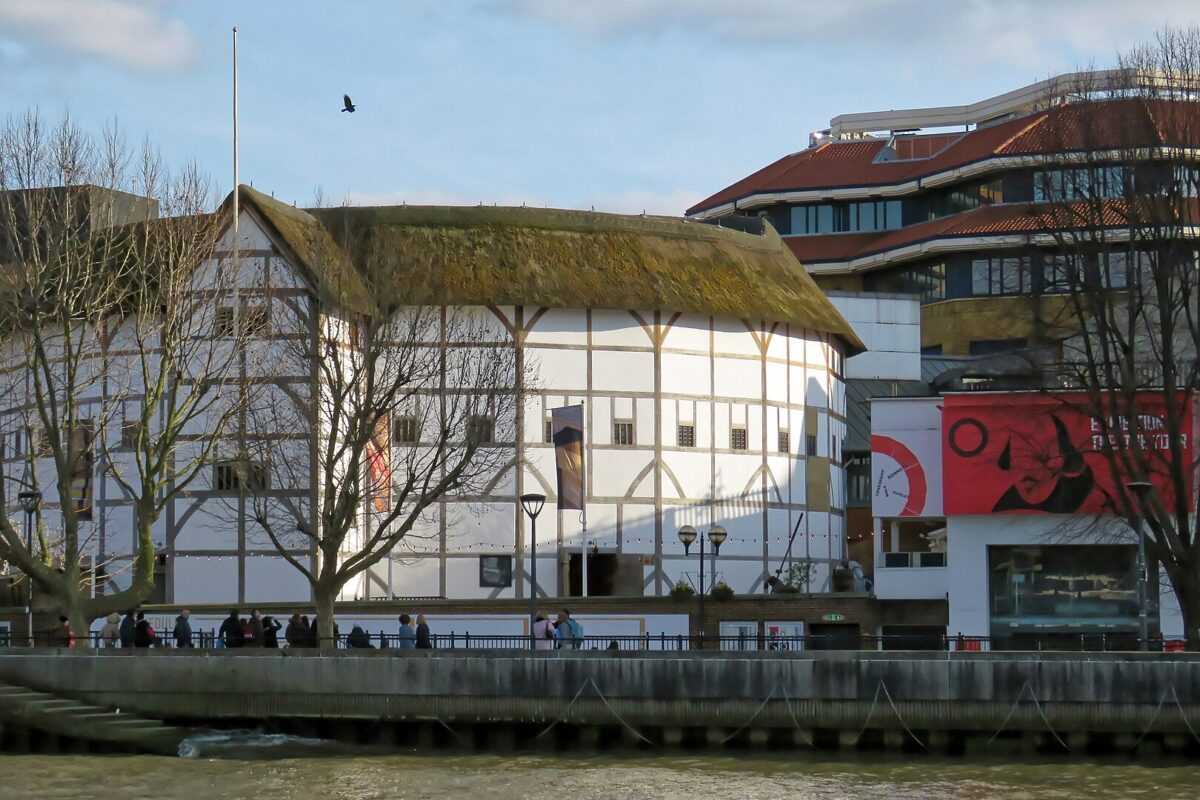
Luckily, the designers and builders learned from the incident. When the Globe was rebuilt in 1614, it featured a tile roof.

Performances at the Globe had no intermission — and no toilets
These days, it’s hard to imagine going to the theatre without the benefit of that 15-minute intermission to stand impatiently in line at the toilets. In Shakespeare’s time, intermissions were non-existent. His notoriously lengthy plays would start at 2 pm and run straight through until they were done.
So, what did theatre goers do if they needed to relieve themselves? Go where they stood (literally). If you could pay more to get a seat in the gallery, that likely bought you access to a chamber pot, which you’d use at your seat.
Luckily, the modern Globe has decided not to honor this less-than-sanitary aspect of the Elizabethan theatre experience. So please, do use the modern toilets.
Related: Like learning lesser-known facts about classic authors? Check out these things you never knew about Charles Dickens and these surprising facts about Thomas Hardy.
Plays were often performed after just one rehearsal
There were so many competing theatres during Elizabethan and Jacobean times, and theatre-going was such a popular pastime, that companies had to constantly come up with new plays to perform. It was common for companies to perform up to five different plays each week.
There were no formal directors, and actors sometimes only had one rehearsal before having to stage a performance. That meant actors in a company would have to have around 15,000 lines memorized each season and be ready to perform roles in multiple different plays at a moment’s notice.
Some plays only ever got performed half a dozen times total. Can you imagine?
The Globe 2.0 was demolished by the Puritans
The rebuilt Globe Theatre might never have attained quite the same level of glory as the first, but it was still popular and successful for many years past Shakespeare’s retirement and death. It continued to show plays to the public until 1644, when the Puritans took control of the English parliament and ordered the destruction of theatres. They wanted to put an end to “stage-plays representative of lascivious mirth and levity”.
Basically, the party was over. Pack it up, go home, and pray for forgiveness for all that joy and fun you had.
Related: One of my favorite resources in learning more about Shakespeare and the Globe was Bill Bryson’s Shakespeare: The World as Stage. Bill Bryson is a delightful author, and one of the best audiobook narrators around. The ebook and audiobook of this are available as part of an Everand subscription, which is what I used to read them.
The current Globe is not in the same spot as the original
While the modern Globe Theatre in London is indeed on the South Bank, it’s not actually built on the spot of the original Globe. After the Globe was torn down in 1644, another building was eventually built on top of it, one of which is still standing today (“Anchor Terrace,” built in 1834).
Because modern builders couldn’t tear down one historical building in order to recreate another, they purchased a plot of land a stone’s throw away and built it there. Still, those interested in the history and facts about the Globe can visit the original site of the theatre and read some informational plaques there.

Related: Shakespeare fans can choose from a number of Shakespeare walking tours in London, which pair perfectly for a visit to the London Globe.
The modern Globe is not an exact replica
While it’s easy to assume the modern Globe Theatre in London is an exact replica of the original, the truth is that such a feat would be impossible, because we don’t actually know what the original looked like. We don’t have any drawings, paintings, or building plans from the original. What the Globe is today is based on a few resources, and piecing them together to the best of their ability.
Here’s what they had to go on:
- Partial archaeological excavation of the foundation of the original Globe (there wasn’t much left, and part of the remains can’t be excavated because they are located underneath a protected historical building)
- A sketch of the interior of another Elizabethan Theatre called The Swan, made by a visiting Dutchman, Johannes de Witt
- References to the theatre in Shakespeare’s play (like “this wooden O” in Henry V)
- A couple panoramic drawings of London at the time, and in particular, “The Long View” by Wenceslas Hollar

The modern Globe was brought about by an American
Although Shakespeare is arguably the most famous writer to have ever come out of England, the replica of his famous theatre actually came about from the efforts of an American actor and film director, Sam Wanamaker. Although he died before the building was completed, it is due to his efforts to procure land and funding that the Globe stands in London today.
Related: During your visit, you can book a Shakespeare afternoon tea at the inn right next to the Globe.
You can find William Shakespeare among the sponsors of the modern Globe
Outside the modern Globe Theatre, you’ll see that each paving stone carries the name of one of the theatre’s major donors. You will find some famous and recognizable names here, like Richard Dreyfuss and other notable actors and filmmakers. But if you look closely, you will find more than a few donors bearing the last name of Shakespeare.
The story for this — according to the tour guide on my last visit to the Globe — is that those who were in charge of soliciting donations sought out every person in the phone book with the last name of Shakespeare and tried to convince them to donate enough to get their own paving stone. And many of them did, including one named William Shakespeare!

Sources & where to learn more
In writing this post, I consulted the following resources, where you can learn more about Shakespeare and his Globe:
- Shakespeare: The World as Stage by Bill Bryson
- A Year in the Life of William Shakespeare by James Shapiro
- A Life of William Shakespeare by Sidney Lee
Tip: All of these titles are included in an Everand subscription, which is what I used to reade them.
Have you ever visited the Globe Theatre? Is it on your literary travel bucket list? Stay tuned for an upcoming post in which I detail how to visit the Globe, whether on a guided tour or to see a performance.
Let me know what other literary destinations are on your bucket list, and don’t forget to pin, share, and sign up for my newsletter so you keep hearing about cool literary facts and destinations.