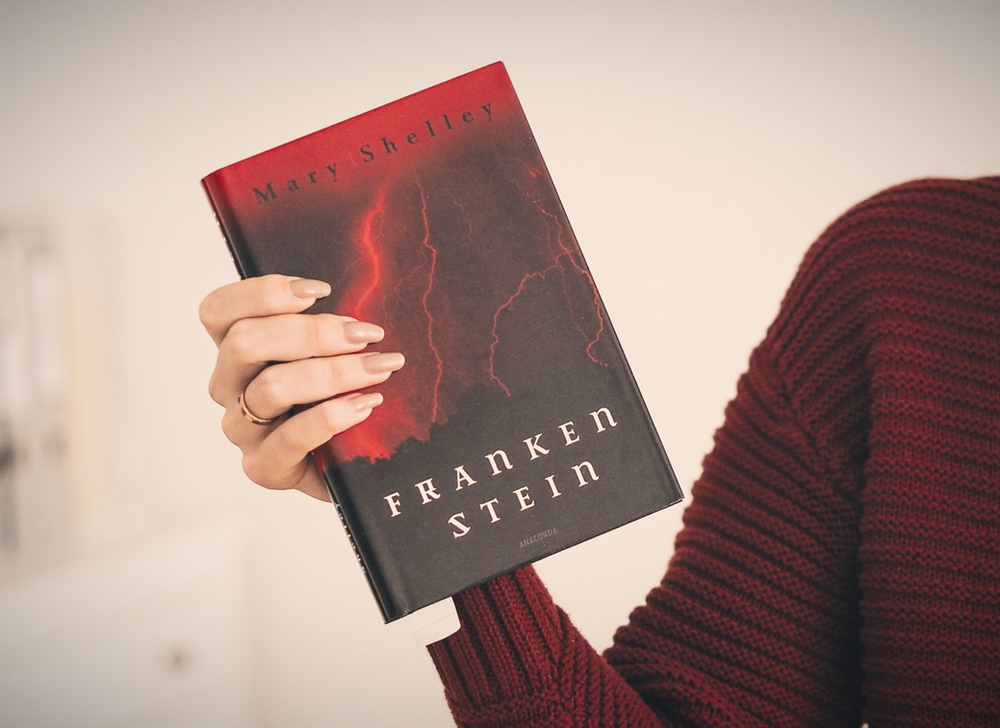
I just don’t think we talk about the original Frankenstein enough, or more specifically, about the kickass woman who wrote it. There are so many interesting facts about Mary Shelley that have gotten lost in the pop culture takeover of Frankenstein, and I’m here to counteract that.
After rereading Frankenstein last year, I realized what an under-appreciated novel it is. You may find that claim surprising because I bet you can probably rattle off at least 3 Frankenstein adaptations off the top of your head, not limited to:
Rocky Horror Picture Show (personal favorite; Tim Curry is a gem)
Universal’s Frankenstein (green guy, square head, bolts in his neck)
Universal’s Bride of Frankenstein
Dracula v. Frankenstein
Victor Frankenstein starring James McAvoy and, weirdly enough, Harry Potter aka Daniel Radcliffe
and so on and so on and so on.
There’s no doubt that the story of Frankenstein and his monster (yes, let’s insert a reminder that Frankenstein is NOT the monster’s name) has made its mark on pop culture. However, the downside of the prolific Frankenstein retellings we are all so familiar with is that we forget how amazing the original Frankenstein is. This story was ground-breaking when it was published on New Year’s Day in 1818.
It’s easy to forget that Frankenstein writer Mary Shelley actually invented the genre of science fiction.
Can we just take a minute to appreciate how unlikely that is? The fact that Mary Shelley, a female writer born in the 1700s, invented science fiction. That alone is remarkable. But the work itself is just plain good. Frankenstein is insightful and thought-provoking but avoids being overly morally didactic, something rare for writers of Shelley’s time. The themes and questions in Frankenstein are so fundamental to life itself that I think just about everyone should read it at some point.
So here I am, on a mission to talk about why Frankenstein should be read and discussed with more nuance by the public at large.
On the first step of this worthy mission, I included it in the list of my top reading recommendations from 2022. Now, for step two, here I am to share a list of interesting facts about Mary Shelley, the author of Frankenstein. (Part 3, literary travel edition, is coming soon, so make sure you subscribe to my blog to get notified of new posts).
Illustration of Frankenstein’s creature from the 1831 revised edition. Image is public domain.
Without further preamble, here are 8 fascinating facts about Frankenstein writer Mary Shelley, whose life is at least as interesting as her most famous work (and hold onto your hats, people… I saved the strangest for last!).
Don’t forget to pin this post for later:
As always, this post may contain affiliate links, which means at no additional cost to you, shopping from them may generate small commissions to support the operations of this blog.
Whenever possible, I recommend buying books at local bookshops or throughBookshop.org, because shopping there puts the profits right into the hands of indie bookstores all over the country.
1. Mary Shelley eloped at 16 with a married poet
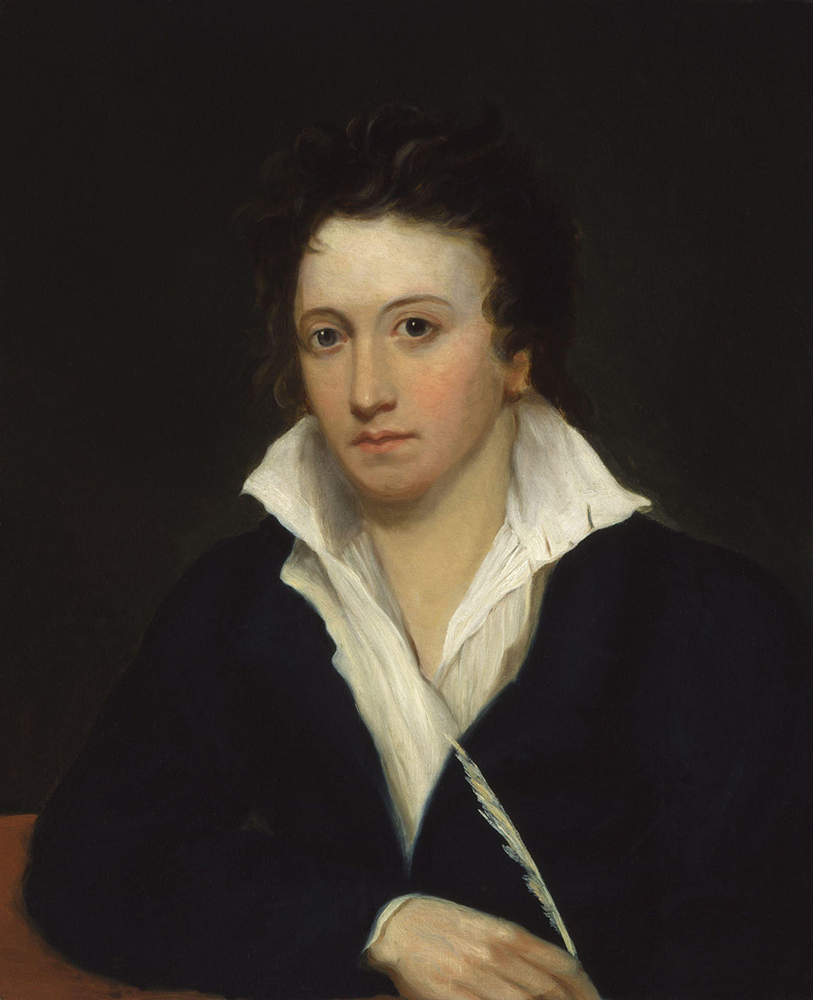
Percy Bysse Shelley: Famous Romantic poet, free love advocate, and husband of Mary Shelley. Image is Public Domain.
We can’t share interesting facts about Mary Shelley without talking about her scandalous love life, so let’s just go ahead and get that part over with so we can talk about some of the other facets of this intriguing writer.
Most people familiar with prominent figures in English literature know that Mary Shelley married notorious Romantic poet Percy Bysse Shelley (if you didn’t know that, congratulations! Impress your friends when you can answer that question correctly when it comes up on Jeopardy). What may be less common knowledge is the relatively salacious nature of their romance, especially by the standards of the early 1800s.
Percy Bysse Shelley was already a husband and father when he and Mary ran off together. Mary was 16, and Percy was 22, a man who’d already earned his bad boy reputation by getting kicked out of Oxford University (word has it, he wrote a pamphlet promoting atheism and then refused to admit it).
Here’s another fascinating fact about Mary and Percy’s love story: strangely enough, much of the literary couple’s courtship took place in a graveyard. That’s right, Mary Godwin was wooed in the cemetery where they would sneak off to visit her mother’s grave.
It was in this cemetery that they declared their love for each other and decided to run away to Europe together. Some people even claim that they consummated their love on top of her mother’s grave, though I’m not sure that’s a verifiable claim. Romantic? I’ll let you decide. But talk about a fun fact about Mary Shelley.
Mary and Percy ran off to Europe in 1814, taking Mary’s step-sister Claire along with them. Free love advocate Percy was anything but a monogamist; he carried on a long-term affair with this step-sister (they later had a child together) and had occasional rendezvous with his jilted wife, Harriett (and sired another child with her), throughout his relationship with Mary.
Despite his famously modern beliefs, Mary’s father, philosopher William Godwin, wasn’t happy about his daughter running off with a married man. He cut her off financially until she was properly married (which she was at the age of 19 after Percy’s wife killed herself).
I think we can safely say that Mary Shelley’s love life alone has enough “interesting facts” to fill a book!
Related: Mary Shelley and husband Percy lived in Bath for a time in 1816, during which period she finished writing Frankenstein. Now, you can visit the truly unique Frankenstein Museum there to learn more about her and her most famous novel.
2. Mary Shelley was the daughter of one of the most famous suffragettes
If you think it strange and random how Mary Shelley would have met and run away with a famous poet like Percy Bysse Shelley, it’s because we need to talk about Mary Shelley’s parents. Shelley’s father was William Godwin, a famous writer and philosopher of the day and a mentor to young Percy.
Mary Shelley’s mother was at least as notable and famous as her father. In fact, she’s known as the mother of feminism and the original suffragette: Mary Wollstonecraft Shelley. That’s right, the mother of feminism gave birth to the mother of science fiction. That’s quite the literary family lineage!
“My own sex, I hope, will excuse me, if I treat them like rational creatures, instead of flattering their fascinating graces, and viewing them as if they were in a state of perpetual childhood, unable to stand alone.”
Sadly, Mary Shelley never got to know her mother, who died only 11 days after giving birth due to childbirth-related complications. It’s known that Mary did study her mother’s writings, and some have identified themes in Frankenstein that seem to have been inspired by her mother’s ideas.
3. Mary Shelley wrote Frankenstein when she was only 19
Portrait of Mary Shelley by Richard Rothwell. Image is Public Domain.
When you get into the study of authors, you quickly realize that there is no formula for what makes a successful writer. I just wrote about Swiss author Johanna Spyri, author of Heidi, who didn’t start writing until her 50s.
At the other end of the spectrum is Frankenstein writer Mary Shelley, who wrote her first and most famous book when she was only 19 years old.
“I have love in me the likes of which you can scarcely imagine and rage the likes of which you would not believe. If I cannot satisfy the one, I will indulge the other.”
Frankenstein by Mary Shelley
It’s hard to imagine how a mere teenager could write so enduringly and provokingly about some of life’s most universal questions and themes, but somehow she managed it. Frankenstein raises deep questions about:
the origins of good and evil, virtue and vice
the contract between creator and creation
the existence of God
The impact of solitude
Human nature’s tendency to judge each other by physical criteria
and more. Her work is so universal, timeless, and even prophetic, that Frankenstein is still worth reading and studying today, more than 200 years after it was published.
4. Frankenstein was inspired by a writing competition with Lord Byron
In June of 1916, Mary Shelley and her husband were on a European tour with some other prominent Romantic writers of the age, including poetic rock star Lord Byron. One night, Lord Byron challenged everyone to a writing competition… who could write the best ghost story?
“I busied myself to think of a story, a story to rival those which had excited us to this task.”
Quote from Mary Shelley’s introduction to the 1831 publication of Frankenstein
While others put forth their stories readily, Mary took her time. She stressed for days about what to write, but when inspiration struck, the result was her first draft of Frankenstein. Percy encouraged her to expand the story, which she did. Frankenstein was published on New Year’s Day, 1818.
We can’t share facts about Mary Shelley without touching on the staggering amount of tragedy that characterized her life, especially in her first 2 1/2 decades. By the age of 25, Mary Shelley had lost nearly everyone she counted family and even some close friends.
First, Shelley’s mother died due to complications giving birth to her.
As a young adult, the Frankenstein writer experienced further tragedies of those close to her: during a one-month period in 1816, Mary Shelley’s half-sister committed suicide, and then Percy’s wife, Harriet, drowned herself in the Serpentine River (Harriet was actually pregnant with Percy’s child at the time).
Motherhood brought on tragedy for her as well: Of Mary Shelley’s five children she gave birth to, only one survived early childhood. Her first child was born prematurely and lived only two weeks. Her youngest daughter died at one year old, and the following year her son William died of malaria. In 1822 she miscarried and nearly died of hemorrhaging, only shortly before her husband, Percy, drowned at sea when his sailboat was caught in storms off the coast of Italy.
All of these losses occurred by the time Shelley was 25 years old.
6. Mary Shelley had a real-life “evil stepmother”
Mary had a strong affection for her father, something not too surprising given he’d raised her since infancy after the death of her mother. When Shelley’s father, William Godwin, eventually remarried, there was apparently a bit of tension and competitiveness between Mary and her stepmother for her father’s affection.
To keep the peace, William and his new wife sent Mary off to Scotland to live with another family, where she would be out of the way of his new wife.
In a sense, things turned out alright if you consider that the scenery of Scotland inspired some of the iconic, moody settings found in Frankenstein.
Related: Did you know there are tea companies that make book-inspired teas, including teas based on Mary Shelley and Frankenstein? Check out my list of recommendations.
7. Mary Shelley wrote one of the first post-apocalyptic novels
One interesting fact about Mary Shelley that few people know is that she not only broke ground by inventing science fiction; she also wrote one of the first post-apocalyptic, dystopian novels.
The Last Man (published in 1826) tells the story of Earth’s last survivor in the 21st century, after a plague, climate change, and armed conflict wiped out the rest of the world’s population (a bit eery, isn’t it?). From Mary Shelley’s journals, we know that she felt her life’s losses heavily and often felt very lonely, a feeling she channeled into this groundbreaking dystopian book.
8. After her husband died, Mary kept his heart in her desk drawer
Yes, you read that fun fact about Mary Shelley correctly.
Percy definitely didn’t make life easy for Mary, what with all of his ongoing affairs and the children he sired then abandoned, but she remained devoted to him. Mary survived Percy by nearly 30 years, but clearly, she still held dearly to his memory until her own death.
A recreation of how they found Percy’s heart in a box in Mary’s drawer
After she died in 1851 of a brain tumor, Mary Shelley’s surviving family members searched the contents of her writing desk. Inside, they found a box with the remains of her husband’s heart, wrapped up in an excerpt of one of his poems, “Adonais,” which he wrote after the death of his friend John Keats.
The story goes that when Percy’s body finally washed ashore in Italy, his friends built a pyre and cremated it right there on the beach. Surprisingly, they found his heart would not burn, so they took up the hardened remains and eventually returned them to Mary, now his widow.
How’s that for a strange Mary Shelley fact?
Hopefully you learned at least one new thing in this post about badass female writer Mary Shelley. Have you read Frankenstein yet? If you haven’t, have I convinced you?
Don’t forget to pin and share this post.
Constance Ray
I'm Constance, an avid reader and traveler. I love tracking down the best literary sights everywhere I go, from the best indie bookstores to author's homes and fictional locations you can visit in real life. I'm also passionate about all things tea and chocolate. I have a BA in English literature and an MS in Nutrition Science.
The Dickens House Museum at 48 Doughty Street is one of my favorite attractions in London. And that’s saying a lot, as I’ve studied abroad there and visited several times since. If you’ve been wondering whether the Charles Dickens house is worth visiting or not, I’m…
If you’re a fan of literature and/or history and are looking for a fun night out in London, the London Literary Pub Crawl might just be the perfect fit. The London Literary Pub Crawl is a guided walking tour takes you pub hopping through Fitzrovia and…
We are continuing Dickens December this week! In case you missed it, last week I told you all about touring the Charles Dickens Museum in London, either in-person or virtually. This week, we will be discussing what is perhaps Dickens’ most famous story. “Marley was dead,…
For a traveling book lover, the Writers’ Museum in Edinburgh, Scotland is a fun stop to include on your tour of one of my favorite cities in the world. I first visited Edinburgh fifteen years ago and fell in love with the city. I will never…
If you’re a book lover looking at spending one day in Bath during your upcoming travels, I’ve got you covered. Bath is one of my favorite day trips from London, though you can certainly make a full weekend out of it like I did on a…
Of all the literary sites to visit in France, the Chateau d’If, aka the “Count of Monte Cristo prison,” has been high on my literary travel bucket list for a while. Now that I’ve finally gotten to visit it, I’m sharing everything you need to know…